Design of the Flag of European Union
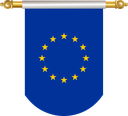
The Flag of European Union features a blue field with a circle of twelve golden five-pointed stars placed at the center.
The stars are evenly spaced and arranged in a perfect circle. Each star points upward, and the number of stars never changes, regardless of how many countries are members of the European Union.
The design is symmetrical, balanced, and intentionally simple, allowing it to be easily recognized worldwide.
Meaning of Colors and Symbols
Each element of the Flag of European Union carries deep symbolic meaning.
The blue background represents peace, unity, and stability. Blue is traditionally associated with harmony and trust and reflects the idea of cooperation among European nations.
The twelve golden stars symbolize unity, solidarity, and harmony among the peoples of Europe. The number twelve is traditionally associated with completeness and perfection, not with the number of member states.
The circular arrangement represents equality and unity, with no beginning or end, symbolizing lasting cooperation.
The gold color represents hope, clarity, and shared values.
Together, these elements express peace, unity, and common purpose across Europe.
Historical Background of the European Union Flag
The Flag of European Union was originally adopted in 1955 by the Council of Europe.
Later, in 1986, it was officially adopted by the European Union as its official flag.
The design was chosen to represent all of Europe rather than a political bloc, which is why it avoids national symbols, borders, or text.
Readers interested in European integration can explore more context on the History of the European Union page.
Political and Regional Significance
The Flag of European Union represents cooperation in areas such as trade, human rights, economic policy, and freedom of movement.
It symbolizes shared democratic values and collaboration among member states while respecting national sovereignty. When displayed, the flag represents unity and collective decision-making rather than individual national authority.
The flag is commonly seen at EU institutions, summits, international agreements, and diplomatic events.
Relationship to National Flags of Europe
The Flag of European Union is designed to complement national flags, not replace them.
At official events, it is displayed alongside the flags of member countries. This visual arrangement reinforces the idea of cooperation while maintaining national identity.
Comparing the EU flag with national flags highlights how shared governance and unity can coexist with sovereignty and cultural diversity.
Modern Use of the Flag of European Union
Today, the Flag of European Union is flown at:
- EU institutions and offices
- Government buildings in member states
- International conferences and summits
- Educational and cultural programs
It also appears on EU documents, passports, currency designs, and public information campaigns. The flag plays an important role in promoting European identity and awareness of shared values.
Its continued use reinforces the idea of unity through cooperation.
Interesting Facts About the Flag of European Union
- It was first adopted in 1955
- The number of stars is always twelve
- It does not represent the number of member states
- Blue symbolizes peace and unity
- It is used across all EU institutions
Questions About the Flag of European Union
What does the Flag of European Union represent?
It represents unity, cooperation, and shared European values.
Why are there twelve stars on the EU flag?
The number twelve symbolizes completeness and unity.
Does the number of stars change when new countries join?
No, the number always remains twelve.
When was the EU flag officially adopted?
It was adopted by the European Union in 1986.
Where is the EU flag commonly displayed?
At EU institutions, government buildings, and international events.