Design Used for the United States Minor Outlying Islands
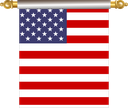
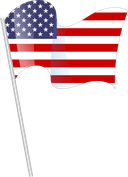
The United States Minor Outlying Islands officially use the Flag of the United States.
This flag features:
- Thirteen horizontal stripes (seven red and six white)
- A blue canton in the upper hoist corner
- Fifty white five-pointed stars arranged in rows
There is no additional emblem, badge, or territorial modification used specifically for the Minor Outlying Islands.
Meaning of Colors and Symbols
Because the U.S. flag represents the United States Minor Outlying Islands, its symbolism applies directly to these territories.
The thirteen stripes represent the original thirteen colonies that formed the United States.
The fifty stars represent the fifty states, symbolizing unity under a federal system.
The red color represents bravery, valor, and sacrifice.
The white color represents purity, integrity, and ideals.
The blue color represents vigilance, perseverance, and justice.
Together, these elements symbolize sovereignty, governance, and national authority over the territories.
What Are the United States Minor Outlying Islands?
The United States Minor Outlying Islands are a statistical grouping of nine small island territories, including:
- Baker Island
- Howland Island
- Jarvis Island
- Johnston Atoll
- Kingman Reef
- Midway Atoll
- Navassa Island
- Palmyra Atoll
- Wake Island
Most of these islands are uninhabited and used for military, scientific, or environmental purposes.
Historical Background of Flag Usage
The United States acquired most of the Minor Outlying Islands during the 19th and early 20th centuries, largely through the Guano Islands Act and strategic expansion.
As these islands were never organized as a unified territory or self-governing entity, no distinct territorial flag was created.
Instead, the Flag of the United States has always served as the official symbol of authority, administration, and sovereignty over these islands.
Readers interested in territorial expansion can explore more context on the History of United States Territories page.
Political and Administrative Significance
The Flag of the United States Minor Outlying Islands represents federal jurisdiction rather than local identity.
The islands are administered by various U.S. federal agencies, including the Department of the Interior and the Department of Defense, depending on location and function.
Flying the U.S. flag on these islands signifies:
- U.S. sovereignty
- Federal authority
- Strategic and environmental importance
The flag serves a legal and administrative purpose rather than a cultural one.
Relationship to Other U.S. Territory Flags
Some U.S. territories, such as Puerto Rico and Guam, have their own local flags in addition to the U.S. flag.
In contrast, the United States Minor Outlying Islands do not have permanent populations or territorial governments, which is why no separate flag exists.
Comparing U.S. territory flags highlights how population, governance, and autonomy influence flag design and symbolism.
Modern Use of the Flag in the Islands
Today, the Flag of the United States is flown on military installations, research stations, and administrative facilities located on some of the islands.
The flag is also used in official documents, maps, and international references to represent the islands collectively.
Its presence emphasizes strategic oversight, environmental protection, and national responsibility.
Interesting Facts About the Flag of the United States Minor Outlying Islands
- The islands do not have a unique flag
- The U.S. flag is used officially
- Most islands are uninhabited
- They are spread across two oceans
- They are grouped for statistical purposes
Questions About the Flag of the United States Minor Outlying Islands
Do the United States Minor Outlying Islands have their own flag?
No, they are officially represented by the Flag of the United States.
Why don’t these islands have a separate flag?
They lack permanent populations and unified territorial governance.
What flag is flown on the islands?
The Flag of the United States.
Are these islands considered part of the United States?
Yes, they are U.S. territories under federal administration.
Where is the flag commonly displayed?
On military, research, and administrative facilities.