Design of the Flag of Nebraska
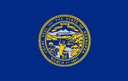
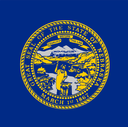
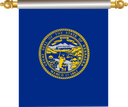
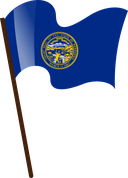
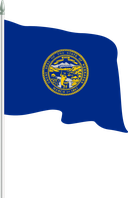
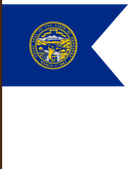
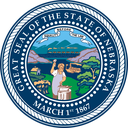
The flag of Nebraska features a dark blue field with the Nebraska state seal placed prominently at the center. Above the seal appears the gold text “STATE OF NEBRASKA”, while the year “1867” is displayed below, marking the year Nebraska became a U.S. state.
The state seal itself is circular and detailed. It depicts a steamboat traveling along a river, a blacksmith working at an anvil, a homesteader’s cabin, wheat sheaves, and distant hills. These elements are arranged to represent the economic foundations and frontier history of Nebraska.
Meaning of the Colors and Symbols
The blue background represents loyalty, justice, and perseverance, values commonly associated with U.S. state flags. It also provides a dignified backdrop that highlights the detailed seal.
Within the seal, the steamboat symbolizes commerce and transportation, reflecting Nebraska’s connection to major rivers and trade routes. The blacksmith represents labor, industry, and craftsmanship, while the wheat sheaves symbolize agriculture, which remains central to Nebraska’s economy.
The homesteader’s cabin represents settlement, pioneering spirit, and family life on the plains. The year 1867 marks Nebraska’s admission to the Union and reinforces the flag’s historical foundation.
The gold lettering and details symbolize value, prosperity, and pride in statehood.
Historical Background and Adoption
Nebraska became the 37th state of the United States in 1867. For many years, the state used its seal on banners and official documents without a standardized flag.
The official flag of Nebraska was adopted on June 1, 1925, following legislative efforts to create a consistent and recognizable state symbol. The design was chosen to reflect Nebraska’s economic development and frontier heritage. More historical context can be found on the history of Nebraska page.
Cultural and State Significance
The Nebraska flag is primarily used in official and governmental contexts. It represents state authority, public institutions, and civic responsibility rather than casual or decorative use.
Among U.S. state flags, Nebraska’s design is often compared with the Flag of Kansas and the Flag of North Dakota, which also feature state seals on blue fields. While traditional in style, Nebraska’s flag clearly communicates the state’s agricultural and industrial roots.
The flag is commonly seen during state holidays, official proclamations, and educational ceremonies.
Official Use and Flag Etiquette
The flag of Nebraska is flown at the State Capitol, courthouses, schools, and municipal buildings. It is typically displayed alongside the Flag of the United States during official events.
Guidelines encourage respectful handling of the flag. It is raised during state observances and lowered according to official protocol during commemorative events.
Design Discussion and Public Perception
Like many state flags featuring seals, Nebraska’s flag has occasionally been discussed in modern design conversations regarding simplicity and visibility. Some advocate for more streamlined designs, while others value the historical detail and symbolism present in the current flag.
Despite these discussions, the flag remains the legally recognized symbol of the state and continues to be used consistently in official contexts.
The Flag as a Symbol of Nebraska’s Identity
The imagery on the Nebraska flag reflects hard work, progress, and community values. From agriculture to industry, the symbols highlight the contributions of everyday citizens to the state’s development.
For residents, the flag serves as a reminder of Nebraska’s frontier past and its continued role as an agricultural and economic contributor within the United States.
Questions About the Flag of Nebraska
When was the flag of Nebraska adopted?
The flag was officially adopted on June 1, 1925.
What does the state seal on the flag represent?
It represents Nebraska’s agriculture, industry, transportation, and settlement history.
Why is the Nebraska flag blue?
Blue symbolizes loyalty, justice, and perseverance.
What is the meaning of the year 1867?
It marks Nebraska’s admission to the United States.
Is the Nebraska flag the same on both sides?
Yes, the design appears on both sides of the flag.