Design of the Flag of Laos
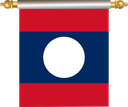
The Flag of Laos consists of three horizontal stripes.
- The top stripe is red
- The middle stripe is blue, double the height of the red stripes
- The bottom stripe is red
At the center of the blue stripe is a white circle.
The layout is symmetrical and visually balanced, with the central symbol drawing immediate attention.
Meaning of Colors and Symbols
Each element of the Flag of Laos carries deep symbolic meaning.
The red stripes represent the blood shed by the Lao people in their struggle for independence and freedom.
The blue stripe represents the Mekong River, which flows through the country and sustains its people. It also symbolizes prosperity and the nation’s natural resources.
The white circle represents unity and integrity of the Lao people. It is also often interpreted as the moon rising over the Mekong River, symbolizing hope and a bright future.
Together, these symbols express sacrifice, unity, and harmony with nature.
Historical Background of the Laos Flag
The Flag of Laos was officially adopted on December 2, 1975, when the Lao People’s Democratic Republic was established.
The design originated earlier, during the Lao Issara (Free Laos) movement, which opposed colonial rule. After independence, the flag was retained as a symbol of national unity rather than royal authority.
Before 1975, Laos used a flag featuring a three-headed elephant, representing the monarchy. The transition to the current flag marked a shift toward a republican identity.
Readers interested in this period can explore more context on the History of Laos page.
Cultural and National Significance
The Flag of Laos holds strong cultural and emotional significance. It represents unity across ethnic groups and respect for shared history.
The flag is prominently displayed during National Day celebrations, public ceremonies, and international events. For citizens, it symbolizes independence, peace, and pride in national identity.
The moon symbolism resonates deeply in Lao culture, where nature and harmony play an important role.
Relationship to Other Southeast Asian Flags
The Flag of Laos shares certain color themes with other Southeast Asian flags, but its design is unique due to the prominent white circle.
Unlike flags that emphasize stars or crests, Laos focuses on unity and geography. Comparing Southeast Asian flags highlights Laos’s emphasis on national cohesion rather than political symbolism.
Modern Use of the Flag of Laos
Today, the Flag of Laos is flown on government buildings, schools, public institutions, and national monuments across the country. It is also displayed at embassies, international organizations, and global sporting events representing Laos abroad.
The flag plays an important role in education and civic life, helping citizens understand national values, history, and unity. Its continued use reinforces Laos’s identity as a peaceful and unified nation.
Interesting Facts About the Flag of Laos
- The blue stripe is wider than the red stripes.
- The white circle represents unity.
- The design dates back to independence movements.
- It was adopted in 1975.
- The Mekong River influences its symbolism.
Frequently Asked Questions
What does the white circle on the Laos flag represent?
It represents unity and the moon over the Mekong River.
When was the Flag of Laos adopted?
It was adopted on December 2, 1975.
Why is the blue stripe wider?
It emphasizes the importance of the Mekong River.
Did Laos previously use a royal flag?
Yes, earlier flags featured a royal elephant.
Where is the Laos flag commonly displayed?
It is flown on public buildings and during national events.