Understanding the Bhutan Country Flag
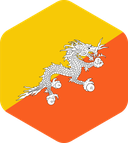
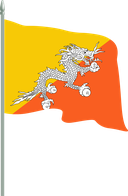
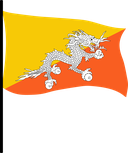
The flag is divided diagonally into yellow and orange sections. Yellow represents Bhutan’s secular tradition and the role of the king. Orange color also signifies the country’s Buddhism mystical belief. The white color dragon is mostly called Druk, linked with Bhutan’s traditional name, Druk Yul, meaning “Land of the Thunder Dragon.”
For anyone researching the flag of Bhutan meaning, the main idea is balance between political leadership, spiritual values, and national protection. A clear Bhutan flag image shows the dragon stretching across both colored sections, visually joining the country’s secular and religious foundations.
The History of Bhutan and Its Flag
The Official modern Bhutan country flag are also established during twentieth century, but the kingdom’s general identity and Buddhist civilizations are older. The dragon persisted vital to the design because it also signifies Bhutan’s unique historic name and cultural personality.
The history of Bhutan was strongly formed by Buddhism traditions, which also befitted dominant from the eighth century. Zhabdrung Ngawang Namgyal combined the country history during the seventeenth century, and the traditional empire began approved in 1907. Bhutan also linked with United Nations in 1971, it also firming its membership in international affairs.
Location, Capital, and Architecture
A Bhutan and india map also shows Bhutan in the eastern Himalayas. India share border with the east, west, and south region, while China lies on the north region. A Bhutan flag map generally dwellings the national flag privileged Bhutan’s geographic outline map, also helping readers to recognize its location and national symbol.
Thimphu is the Bhutan capital city and the country’s main organizational and commercial trade center. Traditional Bhutan architecture also appears in dzongs, convents, shrines, and backgrounds. Public structures also embrace coated woodworking, oblique roofs, representative shapes, and resilient stone or bumped earth partitions. Bhutan’s official travel platform describes this old architecture as a living tradition that also remains visible across all the country.
The Bhutan Economy and Modern Development
The Bhutan economy is supported by hydropower, agriculture, travel & tourism, construction, and genre services. Growth prospects also remain positive, but youth idleness, early immigration, and the need for better paid jobs are continuing to create contests. In April 2026, the World Bank are also reported that Bhutan’s medium term growth outlook may remained strong, while earlier job creation was still necessary for entire youth.
Bhutan also connects its national development with cultural conservation, ecofriendly care, and social welfare. Its Uncultured General Happiness thinking also reflects the maintainable development, good supremacy, cultural defense, and environmental conservation along financial growth.
Frequently Asked Questions
What is Bhutan known for?
Bhutan is known for Gross National Happiness, Himalayan scenery, Buddhist culture, traditional dzongs, environmental protection, and the Tiger’s Nest monastery.
Where is Bhutan situated?
Bhutan is situated in the eastern Himalayas of South Asia, between India to the south and China to the north.
Is Bhutan safe?
Bhutan is generally safe for visitors, but travelers should protect belongings and prepare for possible weather, landslide, road, and mountain hazards.
What is the capital of Bhutan?
Thimphu is Bhutan’s capital and its main center for government, business, education, and cultural institutions.
What is the main religion of Bhutan?
Vajrayana Buddhism is Bhutan’s state religion and is practiced by most citizens, while people may practice other religions.