Official Flag Status of New Caledonia
As a territory of France, the Flag of France is the official state flag of New Caledonia. It is used for governmental, legal, and international purposes and represents French sovereignty.
Alongside the French tricolor, the Kanaky flag has been officially flown with the French flag since 2010, following a political agreement. While the Kanaky flag is not a national flag in the legal sense, it is officially recognized as a symbol of local identity and cultural heritage. More background on this arrangement can be found on the history of New Caledonia page.
Design of the Kanaky Flag
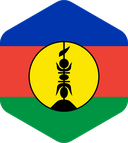
The Kanaky flag features three horizontal stripes of blue, red, and green. At the center of the flag is a yellow disk containing a black flèche faîtière, a traditional Kanak symbol.
The design is bold and symbolic. The horizontal stripes create balance, while the central emblem clearly distinguishes the flag from other tricolors. The Kanaky flag is widely used in cultural, social, and political contexts across New Caledonia.
Meaning of the Colors and Symbols
Each element of the Kanaky flag carries deep cultural meaning.
The blue stripe represents the sky and the surrounding Pacific Ocean, symbolizing openness and connection.
The red stripe represents the blood shed by the Kanak people in their historical struggle, as well as solidarity and shared identity.
The green stripe symbolizes the land, vegetation, and the deep spiritual connection between the Kanak people and their environment.
The yellow disk represents the sun, a source of life and energy. It also symbolizes hope and continuity.
The flèche faîtière is a traditional roof finial found on Kanak houses. It represents leadership, authority, and the connection between ancestors and the living community.
The French Flag in New Caledonia
The French tricolor consists of three vertical stripes of blue, white, and red. In New Caledonia, it represents citizenship, legal authority, and the territory’s status within the French Republic.
The French flag is flown at government buildings, schools, courts, and official ceremonies. It is also used in international representation, confirming that New Caledonia remains part of France in diplomatic contexts.
Historical Background and Dual-Flag Use
New Caledonia was annexed by France in 1853 and remained under French administration throughout the colonial period. Over time, political movements emerged advocating greater autonomy and recognition of Indigenous identity.
The Kanaky flag was created in the 1980s as a symbol of the Kanak independence movement. In 2010, the French government and local leaders agreed to fly both the French flag and the Kanaky flag together, symbolizing respect, reconciliation, and dialogue.
This dual-flag practice reflects New Caledonia’s ongoing political process, including referendums on self-determination held in the 21st century.
Cultural and Political Significance
The flags of New Caledonia play an important role in public life. The Kanaky flag is commonly seen during cultural festivals, community events, and regional ceremonies, while the French flag remains central to official state functions.
Within the Pacific region, New Caledonia’s situation is unique. Its flag usage is often compared with territories such as French Polynesia, which also combine local identity with French national symbols.
The dual-flag system visually represents coexistence rather than replacement.
Official Use and Display
In official settings, both flags are often displayed together, with the French flag typically positioned according to protocol. This practice emphasizes mutual recognition and peaceful political expression.
Respectful handling of both flags is encouraged, as each represents an important aspect of New Caledonia’s identity and governance.
The Flags in Modern New Caledonia
In modern New Caledonia, the presence of two flags reflects diversity, dialogue, and shared space. The flags symbolize cultural recognition, political complexity, and the search for a common future.
Rather than creating division, the dual-flag approach is intended to promote understanding and coexistence among communities.
Questions About the Flag of New Caledonia
Does New Caledonia have an official national flag?
No, it officially uses the French flag, alongside the Kanaky flag for local identity.
What is the Kanaky flag?
It is a flag representing Kanak culture and identity.
Why are two flags flown in New Caledonia?
They represent French sovereignty and local cultural recognition.
What does the flèche faîtière symbolize?
It represents leadership, tradition, and ancestral connection.
Is the Kanaky flag used internationally?
No, international representation is done under the French flag.