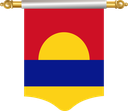
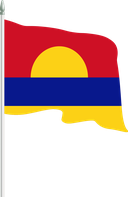
Official Flag Status of Palmyra Atoll
Palmyra Atoll is administered by the United States Department of the Interior, with environmental management overseen in cooperation with conservation organizations. As an unincorporated U.S. territory, Palmyra Atoll does not have a legislature, local government, or separate national identity.
Therefore, the United States flag is the only officially recognized flag associated with Palmyra Atoll. It is used in all legal, administrative, and international contexts. More details about the territory’s background can be found on the history of Palmyra Atoll page.
Design of the Flag Used for Palmyra Atoll
The flag used for Palmyra Atoll is the Flag of the United States of America. It features:
- Thirteen horizontal red and white stripes, representing the original American colonies
- A blue canton in the upper hoist corner containing fifty white stars, each representing a U.S. state
No additional symbols, emblems, or territorial modifications are applied specifically for Palmyra Atoll.
The use of the U.S. flag reinforces the atoll’s status as a federally administered territory rather than a self-governing region.
Meaning of the Flag in the Context of Palmyra Atoll
While the U.S. flag carries national meaning across all American territories, its symbolism has particular relevance for Palmyra Atoll.
The flag represents sovereignty and jurisdiction, confirming Palmyra Atoll as part of the United States. It also symbolizes protection and stewardship, as the atoll is preserved primarily for conservation and scientific research.
Unlike populated territories, Palmyra Atoll’s identity is not cultural or political but environmental. The U.S. flag therefore represents responsibility rather than settlement, highlighting federal commitment to preservation and ecological protection.
Historical Background and Flag Usage
Palmyra Atoll was claimed by the United States in 1859 under the Guano Islands Act, a law that allowed the U.S. to claim uninhabited islands rich in guano deposits.
During World War II, the atoll was used briefly for military purposes, during which the U.S. flag represented American authority. After the war, Palmyra returned to uninhabited status.
In 2001, Palmyra Atoll was designated a National Wildlife Refuge, further reinforcing its role as a protected environmental site rather than a residential territory. Throughout these transitions, the U.S. flag has remained the only official symbol associated with the atoll.
Political and Legal Significance
Palmyra Atoll is unique among U.S. territories because it is the only incorporated U.S. territory, meaning the U.S. Constitution fully applies there, despite the lack of permanent residents.
The continued use of the U.S. flag reflects this legal status. Internationally, Palmyra Atoll is represented exclusively by the United States, and the flag serves as confirmation of legal authority and responsibility.
Palmyra Atoll is often discussed alongside other U.S. Pacific territories such as Midway Atoll and Wake Island, which also rely solely on the U.S. flag.
Cultural and Regional Context
Because Palmyra Atoll has no permanent population, it does not possess a local culture, language, or civic tradition that would normally be represented by a flag.
There has never been an official proposal to create a separate Palmyra Atoll flag, as such a symbol would not reflect its purpose or governance structure.
Instead, the U.S. flag represents administrative oversight, scientific research activity, and environmental stewardship.
Official Use and Display
The U.S. flag is used during official activities related to Palmyra Atoll, including scientific expeditions, conservation management, and federal oversight operations.
Due to restricted access and protected status, flag display is rare and limited to authorized personnel. The flag is not used for tourism, commercial branding, or decorative purposes.
The Flag in Modern Context
In the modern era, the flag associated with Palmyra Atoll symbolizes conservation, research, and legal protection rather than nationalism.
The U.S. flag represents commitment to preserving one of the Pacific’s most pristine coral reef ecosystems and safeguarding marine biodiversity.
Palmyra Atoll’s identity is therefore defined by environmental value, with the flag serving as a marker of responsibility and governance.
Questions About the Flag of Palmyra Atoll
Does Palmyra Atoll have its own flag?
No, it does not have a separate flag and uses the U.S. flag.
Why does Palmyra Atoll use the United States flag?
Because it is an incorporated territory of the United States.
Is Palmyra Atoll inhabited?
No, it has no permanent civilian population.
Has Palmyra Atoll ever used another flag?
No official alternative flag has ever been adopted.
How is Palmyra Atoll represented internationally?
It is represented solely by the United States and its national flag.