Design of the Flag of Vietnam
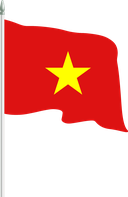
The Flag of Vietnam features a solid red field with a large yellow five-pointed star placed at the center.
The proportions of the flag are carefully defined, ensuring that the star remains the focal point. There are no additional symbols, borders, or stripes, giving the flag a clean and bold appearance.
This simplicity makes the flag highly visible and symbolic.
Meaning of Colors and Symbols
Each element of the Flag of Vietnam carries deep symbolic meaning.
The red background represents the blood shed by Vietnamese patriots during the struggle for independence and national liberation. It also symbolizes revolution, courage, and sacrifice.
The yellow five-pointed star represents the unity of the people under socialism. Each point of the star symbolizes a key group in Vietnamese society:
- Intellectuals
- Farmers
- Workers
- Soldiers
- Youth
The yellow color of the star represents prosperity, hope, and the Vietnamese people themselves.
Together, the red and yellow colors express unity, revolution, and national strength.
Historical Background of the Vietnam Flag
The Flag of Vietnam originated during the anti-colonial movement against French rule.
A version of the flag was first used in 1940 during uprisings led by revolutionary forces. It was officially adopted in 1945 when the Democratic Republic of Vietnam was proclaimed following the August Revolution.
After the reunification of North and South Vietnam in 1976, the flag of North Vietnam became the official national flag of the unified country.
Readers interested in colonial resistance and reunification can explore more context on the History of Vietnam page.
Cultural and National Significance
The Flag of Vietnam holds strong emotional and cultural importance for Vietnamese citizens.
It represents independence, resilience, and national unity after decades of conflict and division. The flag is prominently displayed during National Day, revolutionary anniversaries, state ceremonies, and public celebrations.
For many Vietnamese people, the flag symbolizes pride in national survival and collective achievement.
Relationship to Other Socialist Flags
The Flag of Vietnam shares similarities with other socialist national flags, particularly in its use of red and a single prominent symbol.
However, Vietnam’s flag is distinct in its use of a large central star rather than multiple symbols or emblems. Comparing socialist flags highlights Vietnam’s emphasis on unity across social classes.
Its design prioritizes clarity and ideological symbolism.
Modern Use of the Flag of Vietnam
Today, the Flag of Vietnam is flown on government buildings, schools, public institutions, and private homes throughout the country.
It is also displayed at embassies, international organizations, and global sporting events representing Vietnam abroad. The flag plays an important role in education, reinforcing lessons about independence, unity, and national history.
Its continued use strengthens Vietnam’s identity as a sovereign and unified nation.
Interesting Facts About the Flag of Vietnam
- It was officially adopted in 1945
- The star has five points representing social unity
- Red symbolizes revolution and sacrifice
- The design remained unchanged after reunification
- It is one of the simplest Asian flags
Questions About the Flag of Vietnam
What do the colors of the Vietnam flag represent?
Red represents sacrifice and revolution, while yellow represents the people and prosperity.
What does the star on the Vietnam flag symbolize?
It symbolizes unity among different social groups.
When was the Flag of Vietnam officially adopted?
It was adopted in 1945.
Did the flag change after Vietnam was reunified?
No, the same flag was retained after reunification in 1976.
Where is the Vietnam flag commonly displayed?
On public buildings and during national events.