Design of the Flag of Trinidad and Tobago
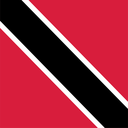
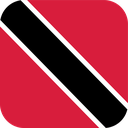
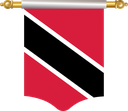
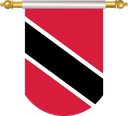
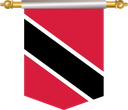
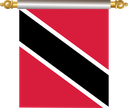
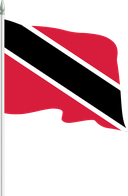
The Flag of Trinidad and Tobago features a red background that covers the entire field.
Running diagonally from the upper hoist corner to the lower fly corner is a black stripe, bordered on both sides by thin white lines.
The diagonal layout gives the flag a sense of movement and strength, making it instantly recognizable.
Meaning of Colors and Symbols
Each color of the Flag of Trinidad and Tobago carries strong symbolic meaning.
The red color represents vitality, energy, and the warmth of the sun. It symbolizes courage, enthusiasm, and the life force of the people.
The black stripe represents strength, dedication, and the resilience of the nation’s people. It reflects unity and determination in overcoming challenges.
The white lines represent purity, equality, and the sea that surrounds the islands. White also symbolizes harmony and shared values.
Together, these colors express energy, strength, and unity, forming a powerful national message.
Historical Background of the Trinidad and Tobago Flag
The Flag of Trinidad and Tobago was officially adopted on August 31, 1962, the day the country gained independence from British colonial rule.
Before independence, Trinidad and Tobago used British colonial flags. As independence approached, a national competition was held to design a new flag that would reflect a confident and modern nation.
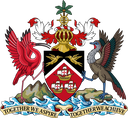
The chosen design emphasized simplicity, boldness, and cultural unity, avoiding colonial symbols and coats of arms.
Readers interested in independence and nation-building can explore more context on the History of Trinidad and Tobago page.
Cultural and National Significance
The Flag of Trinidad and Tobago holds strong cultural importance and is a symbol of pride for citizens at home and abroad.
The flag is prominently displayed during Independence Day, Carnival celebrations, national ceremonies, and international sporting events. For Trinidadians and Tobagonians, it represents freedom, diversity, and national confidence.
Its bold diagonal design reflects the nation’s dynamic culture, music, and creativity.
Relationship to Other Caribbean Flags
The Flag of Trinidad and Tobago is unique among Caribbean national flags due to its diagonal stripe and limited color palette.
While many Caribbean flags feature coats of arms or horizontal stripes, Trinidad and Tobago chose a modern, abstract design. Comparing Caribbean flags highlights the country’s forward-looking and confident identity.
Its design influenced later flags that favored simplicity and symbolism over complex emblems.
Modern Use of the Flag of Trinidad and Tobago
Today, the Flag of Trinidad and Tobago is flown on government buildings, schools, public institutions, and private homes across the country. It is also displayed at embassies, international organizations, and global events representing the nation abroad.
The flag plays an important role in education and civic life, helping citizens understand independence, unity, and shared responsibility. Its continued use reinforces national pride and Caribbean identity.
Interesting Facts About the Flag of Trinidad and Tobago
- It was adopted in 1962.
- It has a diagonal stripe design.
- It uses only three colors.
- It symbolizes independence from colonial rule.
- It is one of the Caribbean’s most distinctive flags.
Questions About the Flag of Trinidad and Tobago
What do the colors of the Trinidad and Tobago flag represent?
Red represents energy, black represents strength, and white represents unity and the sea.
When was the Flag of Trinidad and Tobago adopted?
It was adopted on August 31, 1962.
Why does the flag have a diagonal stripe?
The diagonal stripe symbolizes movement, strength, and progress.
Is the flag unique in the Caribbean?
Yes, its diagonal design makes it stand out among Caribbean flags.
Where is the Trinidad and Tobago flag commonly displayed?
It is flown on public buildings and during national events.