Design of the Flag of Singapore
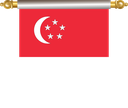
The flag of Singapore consists of two horizontal stripes of equal height:
- Red on the top
- White on the bottom
On the upper hoist side of the red stripe, there is a white crescent moon accompanied by five white five-pointed stars arranged in a circle.
The design is clean and balanced, combining strong symbolism with simplicity. The placement of the crescent and stars gives the flag a distinct identity among Asian national flags.
Meaning of the Colors and Symbols
Each element of the Singapore flag carries specific symbolic meaning.
The red color represents universal brotherhood and equality of mankind. It reflects unity and shared humanity across Singapore’s diverse population.
The white color symbolizes purity, virtue, and integrity, emphasizing moral values and honesty in governance and society.
The crescent moon represents a young nation on the rise, symbolizing growth, progress, and a forward-looking outlook.
The five stars represent the nation’s five ideals:
- Democracy
- Peace
- Progress
- Justice
- Equality
Together, these elements express Singapore’s commitment to harmony, fairness, and national development.
Historical Background and Adoption
Before self-governance, Singapore used British colonial flags as part of the Straits Settlements. After World War II, the push for self-rule led to the creation of new national symbols.
The flag of Singapore was officially adopted on December 3, 1959, when Singapore became a self-governing state within the British Empire.
When Singapore separated from Malaysia and became fully independent on August 9, 1965, the same flag was retained, reinforcing continuity and national identity.
The design was carefully chosen to reflect unity in a multi-ethnic society. More historical context can be found on the history of Singapore page.
Cultural and National Significance
The Singapore flag holds strong national importance and is widely displayed during National Day celebrations, public holidays, and official ceremonies.
It represents unity among Singapore’s diverse ethnic and religious communities, including Chinese, Malay, Indian, and others.
The crescent and stars are often misunderstood as religious symbols, but in Singapore’s context, they represent national values rather than religion.
Among Southeast Asian flags, Singapore’s design stands out for its clarity and symbolic balance.
Official Use and Flag Etiquette
The flag of Singapore is flown at government buildings, schools, embassies, and public institutions.
It is displayed during diplomatic meetings, international events, and sporting competitions.
Respectful handling of the flag is encouraged. It should be kept clean, displayed correctly, and treated as a symbol of sovereignty and unity.
Singapore has specific guidelines on flag display, especially during national celebrations and public campaigns.
The Flag in Modern Singapore
In modern Singapore, the flag symbolizes stability, progress, and global connectivity. It appears in education, tourism promotion, and international diplomacy.
The flag is prominently featured during National Day Parades, reinforcing national pride and shared identity.
It is also embraced by Singaporeans abroad as a symbol of home and belonging.
Design Strength and Recognition
The Singapore flag is admired for its simplicity and clarity of meaning. With just two colors and a small set of symbols, it communicates complex national ideals effectively.
Its balanced layout ensures high visibility and easy recognition worldwide.
The design’s timeless quality has kept it relevant since its adoption.
Questions About the Flag of Singapore
When was the flag of Singapore adopted?
It was adopted on December 3, 1959.
What does the crescent moon represent?
It represents a young nation on the rise.
What do the five stars symbolize?
They represent democracy, peace, progress, justice, and equality.
Is the red color linked to any political ideology?
No, it represents unity and brotherhood.
Is the Singapore flag the same on both sides?
Yes, the design appears on both sides of the flag.