Design of the Flag of Wallis and Futuna
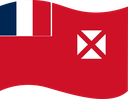
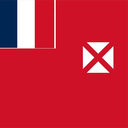
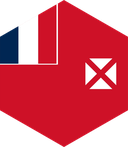
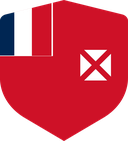
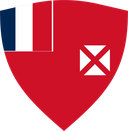
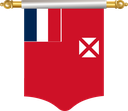
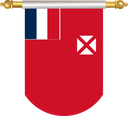
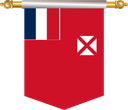
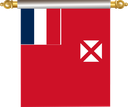
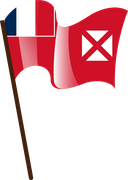
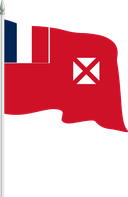
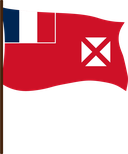
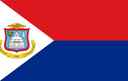
The Flag of Wallis and Futuna most commonly features a red field with symbolic elements connected to France.
In the upper hoist corner, there is a small French tricolor (blue, white, and red).
Centered on the red field is a white emblem, often shown as a square or stylized cross-like shape, sometimes interpreted as four triangles forming a cross.
It is important to note that this flag is not officially standardized in law, but it is widely used locally and informally to represent the territory.
Meaning of Colors and Symbols
Each element of the Flag of Wallis and Futuna carries symbolic meaning tied to governance and identity.
The red background represents strength, authority, and traditional leadership. Red is also commonly associated with Polynesian culture and ceremonial power.
The French tricolor symbolizes Wallis and Futuna’s status as a French overseas collectivity and reflects political and administrative authority under France.
The white emblem is often interpreted as a symbol of Christianity, unity, or traditional authority. Christianity plays a central role in local culture, and the emblem reflects moral guidance and community cohesion.
Together, these elements express loyalty to France while acknowledging local cultural and religious identity.
Historical Background of the Wallis and Futuna Flag
Wallis and Futuna became a French protectorate in 1887 and later an overseas territory in 1961.
Throughout its modern history, the French flag has remained the official national flag used for legal and international purposes. However, a local flag emerged over time for cultural and regional representation.
Because Wallis and Futuna has strong traditional leadership structures alongside French administration, the use of an informal local flag reflects this dual system of governance.
Readers interested in colonial administration and Polynesian governance can explore more context on the History of Wallis and Futuna page.
Cultural and Territorial Significance
The Flag of Wallis and Futuna holds symbolic importance at the local level.
It is commonly displayed during cultural festivals, traditional ceremonies, and regional events. For residents, the flag represents identity, tradition, and recognition within the broader French Republic.
Traditional kings and chiefs continue to play important roles in local society, and the flag visually reflects respect for both modern administration and ancestral authority.
Relationship to the Flag of France
The Flag of Wallis and Futuna is always used alongside the Flag of France, which remains the official national flag.
France’s tricolor symbolizes sovereignty, citizenship, and international representation. The local flag complements it by emphasizing regional culture rather than replacing national authority.
Comparing French overseas flags highlights how territories maintain identity while remaining politically integrated with France.
Modern Use of the Flag of Wallis and Futuna
Today, the Flag of Wallis and Futuna is used primarily in local contexts, such as community events, cultural celebrations, and informal displays.
For official government functions and international representation, the French flag is used exclusively. Schools and public institutions may display both flags together to represent dual identity.
The flag plays an educational role, helping residents understand their cultural heritage and political status.
Interesting Facts About the Flag of Wallis and Futuna
- It is not officially standardized by law
- The French flag remains the official national flag
- The local flag is used informally
- Christianity strongly influences symbolism
- Traditional leadership remains important
Questions About the Flag of Wallis and Futuna
Does Wallis and Futuna have an official national flag?
No, the French flag is the official national flag.
Why is there a local flag for Wallis and Futuna?
It represents local identity and tradition.
What does the French tricolor symbolize on the flag?
It represents French sovereignty and administration.
Is the Wallis and Futuna flag used internationally?
No, France represents the territory internationally.
Where is the Wallis and Futuna flag commonly displayed?
At cultural events and local ceremonies.