Design of the Flag of Myanmar
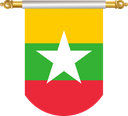
The flag of Myanmar features three horizontal stripes of equal width. From top to bottom, the colors are yellow, green, and red. At the center of the flag is a large white five-pointed star that spans across all three stripes.
The design is symmetrical and visually balanced. The bright colors give the flag a strong presence, while the central star provides a unifying focal point. The simplicity of the layout makes the flag easily recognizable and suitable for widespread use.
Meaning of the Colors and Symbols
Each color on the Myanmar flag carries symbolic meaning connected to national values.
The yellow stripe represents solidarity and unity among the people. It reflects cooperation and mutual respect within Myanmar’s diverse society.
The green stripe symbolizes peace, tranquility, and the country’s natural environment, including its forests and agricultural lands.
The red stripe represents courage, strength, and determination, honoring the sacrifices made in the struggle for independence and national development.
The white star at the center represents the unity of the nation. It symbolizes the coming together of different ethnic groups and regions under one sovereign state, emphasizing harmony and shared purpose.
Historical Background and Adoption
Myanmar, formerly known as Burma, gained independence from British colonial rule in 1948. Over the decades, the country used several different flags reflecting political changes and governance structures.
The current flag was officially adopted on October 21, 2010, alongside the introduction of a new constitution and a change in the country’s official English name to Myanmar. The adoption marked a symbolic shift toward a new national identity and governance framework. More background on this transition can be found on the history of Myanmar page.
Cultural and National Significance
The Myanmar flag is widely used during national holidays, public ceremonies, and international events. It represents national unity rather than political ideology, making it an inclusive symbol for the country’s diverse population.
Within Southeast Asia, Myanmar’s flag is often compared with the Flag of Laos and the Flag of Thailand, though its central white star and color arrangement make it distinct. The flag’s design emphasizes harmony and cooperation rather than historical conflict.
Official Use and Flag Etiquette
The flag of Myanmar is flown at government buildings, schools, embassies, and public institutions. It is also displayed during diplomatic meetings and international sporting events.
Respectful handling of the flag is encouraged. It should be displayed properly and treated as a symbol of national unity and sovereignty. During official ceremonies, the flag is raised and lowered in accordance with established protocols.
The Flag in Modern Myanmar
In modern Myanmar, the flag is used as a symbol of national identity across different regions and communities. It appears in educational settings, public celebrations, and official publications.
Despite political challenges, the flag remains a recognized national symbol representing the country as a whole rather than any single group or movement.
Design Simplicity and Recognition
One of the strengths of the Myanmar flag is its simplicity. With only three colors and a single star, it achieves clarity and strong visual impact.
The use of bright colors ensures high visibility, while the central star reinforces the message of unity. This design approach aligns with many modern national flags that prioritize symbolism and recognition.
Questions About the Flag of Myanmar
When was the flag of Myanmar adopted?
The current flag was adopted on October 21, 2010.
What do the colors on the Myanmar flag represent?
They represent unity (yellow), peace and nature (green), and courage (red).
What does the white star symbolize?
It symbolizes national unity and solidarity among Myanmar’s people.
Did Myanmar use different flags before 2010?
Yes, several flags were used during earlier political periods.
Is the Myanmar flag the same on both sides?
Yes, the design appears on both sides of the flag.