Design of the Flag of Suriname
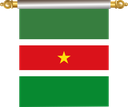
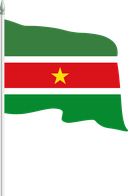
The Flag of Suriname consists of five horizontal stripes arranged symmetrically:
- Green stripe at the top
- White stripe below it
- Wide red stripe in the center
- White stripe above the bottom
- Green stripe at the bottom
At the center of the red stripe is a large golden five-pointed star.
The central red stripe is wider than the others, making the star the main focal point of the flag.
Meaning of Colors and Symbols
Each element of the Flag of Suriname carries clear symbolic meaning.
The green stripes represent Suriname’s fertile land, agriculture, and natural wealth. They symbolize growth, hope, and connection to nature.
The white stripes represent peace, justice, and unity. They emphasize harmony among Suriname’s diverse population.
The red stripe represents progress, sacrifice, and determination. It symbolizes the strength and effort required to build an independent nation.
The golden star represents unity and a shared future. Its five points symbolize the coming together of different ethnic groups into one nation.
Together, these elements express cooperation, freedom, and national development.
Historical Background of the Suriname Flag
The Flag of Suriname was officially adopted on November 25, 1975, the day Suriname gained independence from the Netherlands.
Before independence, Suriname used the Dutch national flag and later a colonial flag with multiple stars representing ethnic groups. After independence, leaders chose a single star to emphasize national unity rather than division.
The new design marked a fresh national identity rooted in equality and shared purpose.
Readers interested in this transition can explore more context on the History of Suriname page.
Cultural and National Significance
The Flag of Suriname holds deep cultural importance because it represents unity among people of African, Indian, Javanese, Indigenous, and European descent.
The flag is prominently displayed during Independence Day, cultural festivals, and national ceremonies. For Surinamese citizens, it symbolizes cooperation, respect, and pride in diversity.
The golden star has become a widely recognized symbol of Suriname’s national identity.
Relationship to Other South American Flags
The Flag of Suriname stands out among South American national flags due to its unique color pattern and central star.
While many regional flags use coats of arms or simple tricolors, Suriname’s flag emphasizes unity through symbolism rather than complex emblems. Comparing South American flags highlights Suriname’s focus on multicultural harmony.
Modern Use of the Flag of Suriname
Today, the Flag of Suriname is flown on government buildings, schools, public institutions, and national landmarks throughout the country. It is also displayed at embassies, international organizations, and sporting events representing Suriname abroad.
The flag plays an important role in civic education, helping citizens understand independence, unity, and national responsibility. Its continued use reinforces Suriname’s identity as a diverse and sovereign nation.
Interesting Facts About the Flag of Suriname
- It was adopted in 1975.
- The central stripe is wider than others.
- The single star represents unity.
- It replaced a multi-star colonial flag.
- It symbolizes multicultural harmony.
Questions About the Flag of Suriname
What does the star on the Suriname flag represent?
It represents unity and a shared national future.
When was the Flag of Suriname adopted?
It was adopted on November 25, 1975.
Why does the Suriname flag have five stripes?
They represent land, peace, progress, and balance.
What do the colors of the Suriname flag symbolize?
Green symbolizes land, white symbolizes peace, and red symbolizes progress.
Where is the Suriname flag commonly displayed?
It is flown on public buildings and during national events.