Design of the Flag of Guadeloupe
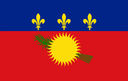
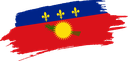
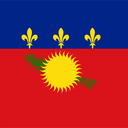
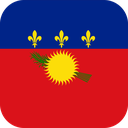
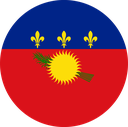
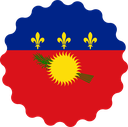
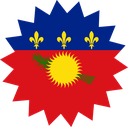
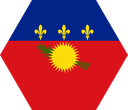
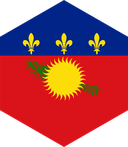
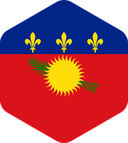
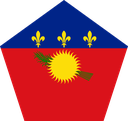
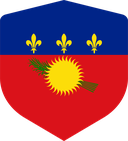
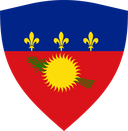
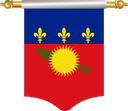
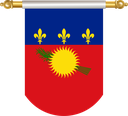
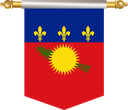
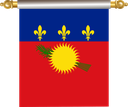
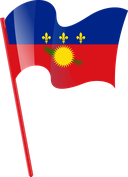
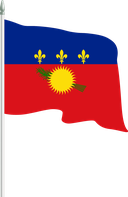
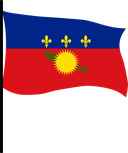
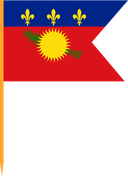
The commonly recognized Flag of Guadeloupe features a black field with a golden sun at the top center. Below the sun is a green sugarcane plant, and at the base of the design is a blue horizontal band with three golden fleurs-de-lis.
The layout is bold and symbolic rather than minimalist. The strong contrast between black, gold, green, and blue makes the flag visually striking and instantly recognizable as a Caribbean regional emblem.
Meaning of Colors and Symbols
Each element of the Flag of Guadeloupe carries cultural and historical meaning.
The black background represents the African heritage of the Guadeloupean people and also symbolizes strength and resilience through history.
The golden sun represents life, energy, and the tropical climate of the Caribbean. It symbolizes hope, warmth, and continuity.
The green sugarcane represents agriculture and the historical importance of sugarcane cultivation in Guadeloupe’s economy. It also reflects fertility and connection to the land.
The blue band represents the Caribbean Sea that surrounds the islands, highlighting maritime identity and trade routes.
The three golden fleurs-de-lis symbolize Guadeloupe’s historical connection to France and its colonial past.
Together, these elements express heritage, environment, and political history.
Historical Background of the Guadeloupe Flag
Guadeloupe became a French overseas department in 1946, which means it is legally part of France. As a result, the Flag of France is the only official flag used for governmental and international purposes.
The local Flag of Guadeloupe developed as a cultural and regional symbol rather than an officially adopted state flag. It gained popularity through cultural expression, tourism, and regional identity movements.
Readers interested in the broader historical context can explore more details on the History of Guadeloupe page, which explains colonial development and political status.
Cultural and Regional Significance
The Flag of Guadeloupe holds strong cultural significance for residents, even though it is not an official national flag. It represents pride in Caribbean identity, African roots, and local traditions.
The flag is often displayed during cultural festivals, sporting events, and community celebrations. For many people, it symbolizes belonging, heritage, and recognition of Guadeloupe’s unique identity within the French Republic.
Relationship to the Flag of France
As an overseas department, Guadeloupe officially uses the Flag of France for all legal and administrative purposes. The French tricolor represents citizenship, law, and international representation.
The Flag of Guadeloupe, however, serves as a regional and cultural symbol. This dual-flag situation reflects the balance between local identity and national belonging.
Relationship to Other Caribbean Regional Flags
The Flag of Guadeloupe shares similarities with other Caribbean regional flags that emphasize local culture rather than sovereignty. Many Caribbean territories under European administration use unofficial flags to express regional pride.
Compared to independent Caribbean nations, Guadeloupe’s flag focuses more on heritage and environment than political independence.
Modern Use of the Flag of Guadeloupe
Today, the Flag of Guadeloupe is widely used in cultural contexts, tourism promotion, and local events. It appears in art, media, festivals, and sporting competitions representing the island.
The flag plays an educational role by highlighting Guadeloupe’s history, agriculture, and cultural diversity. Its continued use reinforces regional identity while acknowledging French governance.
Interesting Facts About the Flag of Guadeloupe
- The flag is not officially recognized by France.
- It features sugarcane, a key agricultural symbol.
- The fleurs-de-lis reflect French heritage.
- The sun symbolizes tropical life.
- It is mainly used for cultural representation.
Frequently Asked Questions
Is the Guadeloupe flag an official national flag?
No, the official flag is the Flag of France.
What does the sugarcane on the Guadeloupe flag represent?
It represents agriculture and economic history.
Why are there fleurs-de-lis on the flag?
They symbolize historical ties to France.
When did Guadeloupe become part of France?
It became an overseas department in 1946.
Where is the Guadeloupe flag commonly displayed?
At cultural events, festivals, and regional celebrations.