Design of the Flag of Nicaragua
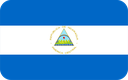
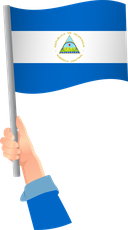
The flag of Nicaragua features three horizontal stripes of equal width. The top and bottom stripes are blue, while the middle stripe is white. At the center of the white stripe is the national coat of arms of Nicaragua.
The layout is simple and symmetrical, allowing the coat of arms to stand out clearly. The blue-white-blue tricolor is a common regional design in Central America, symbolizing shared history and cooperation among neighboring nations.
Meaning of the Colors and Symbols
Each color and symbol on the Nicaraguan flag carries clear meaning.
The blue stripes represent the Pacific Ocean and the Caribbean Sea, which border Nicaragua on the west and east. Blue also symbolizes justice, loyalty, and strength.
The white stripe represents peace, purity, and national unity. It reflects Nicaragua’s aspiration for harmony within the country and peaceful relations with other nations.
The coat of arms is rich in symbolism. It features a triangle containing five volcanoes, representing the original five member states of the United Provinces of Central America. The volcanoes also symbolize strength and the region’s volcanic landscape.
Above the volcanoes is a Phrygian cap, symbolizing liberty and freedom. Above it appears a rainbow, representing hope and peace. The triangle itself stands for equality and justice.
Historical Background and Adoption
Nicaragua was part of the United Provinces of Central America in the early 19th century after gaining independence from Spanish rule in 1821. During this period, the blue and white tricolor became a regional symbol.
Although Nicaragua later became a separate republic, it retained the tricolor design to emphasize shared Central American heritage. The current version of the flag, with the national coat of arms, was officially adopted on August 27, 1971.
The design reflects both national independence and regional unity. More historical context can be found on the history of Nicaragua page.
Cultural and National Significance
The Nicaraguan flag holds strong cultural importance and is displayed during national holidays, Independence Day celebrations, and public ceremonies.
Within Central America, Nicaragua’s flag is closely related to the Flag of Honduras and the Flag of El Salvador, which share similar colors and symbols. However, Nicaragua’s coat of arms gives it a distinct national identity.
The flag represents peace, cooperation, and pride in Nicaragua’s heritage.
Official Use and Flag Etiquette
The flag of Nicaragua is flown at government buildings, schools, embassies, and public institutions. It is also used during international events and diplomatic meetings.
Guidelines encourage respectful handling of the flag. It should be displayed properly, kept clean, and treated as a symbol of national unity and sovereignty.
During national observances, the flag may be raised or lowered in accordance with official protocol.
The Flag in Modern Nicaragua
In modern Nicaragua, the flag continues to symbolize national identity and continuity. It appears at sporting events, cultural festivals, and international gatherings.
Despite political and social challenges, the flag remains a unifying symbol representing the nation as a whole rather than any specific group or ideology.
Design Simplicity and Regional Identity
The Nicaraguan flag’s simple tricolor design ensures easy recognition and reflects its regional roots. The inclusion of the coat of arms adds historical depth without overwhelming the design.
This balance between simplicity and symbolism makes the flag both practical and meaningful.
Questions About the Flag of Nicaragua
When was the flag of Nicaragua adopted?
The current version was adopted on August 27, 1971.
What do the blue stripes represent?
They represent the Pacific Ocean and the Caribbean Sea.
What do the five volcanoes symbolize?
They represent the original five Central American states.
Why is there a triangle in the coat of arms?
It symbolizes equality and justice.
Is the Nicaragua flag the same on both sides?
Yes, the design appears on both sides of the flag.