Design of the Flag of Michigan
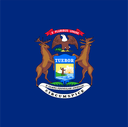
The flag of Michigan features a dark blue background with the Michigan coat of arms placed prominently in the center. Above the coat of arms appears the United States bald eagle, holding an olive branch and arrows, symbolizing national authority and peace.
The central shield displays a man standing on a peninsula between a lake and land, with one hand raised and the other holding a long gun. On either side of the shield are a moose and an elk, supporting the emblem. Below and above the shield are banners displaying Latin mottos that further define the state’s values and identity.
Meaning of the Colors and Symbols
The dark blue field is commonly used in U.S. state flags and represents loyalty, justice, and perseverance. It also provides a formal background that highlights the detailed coat of arms.
The bald eagle represents the United States and Michigan’s place within the federal union. Its presence emphasizes national unity and constitutional authority.
The shield symbolizes Michigan’s natural environment and frontier history. The man represents peace and the willingness to defend the state, while the raised hand signifies peace and goodwill. The gun reflects readiness and protection during early settlement periods.
The moose and elk represent Michigan’s abundant wildlife and natural resources. These animals emphasize the importance of nature, hunting, and conservation in the state’s development.
Latin Mottos on the Flag
Michigan’s flag includes three Latin mottos, each adding depth to its symbolism.
The top motto, “E Pluribus Unum,” means “Out of many, one,” highlighting unity among the states.
The central motto, “Tuebor,” means “I will defend,” reflecting the state’s readiness to protect its people and values.
The bottom motto, “Si quaeris peninsulam amoenam, circumspice,” translates to “If you seek a pleasant peninsula, look about you.” This phrase celebrates Michigan’s geography and natural beauty, particularly its two peninsulas surrounded by the Great Lakes.
Historical Background and Adoption
Michigan became the 26th state of the United States in 1837. Early versions of state symbols evolved over time, but the current flag design was officially adopted in 1911.
The design reflects Michigan’s growth from a frontier territory into a developed state while maintaining a strong connection to nature and exploration. For more background on this development, readers can explore the history of Michigan page.
Cultural and State Significance
The Michigan flag is widely used at state government buildings, schools, and official events. It represents state authority and civic identity rather than casual or decorative use.
Among U.S. state flags, Michigan’s design is often compared with the Flag of Pennsylvania and the Flag of New York, which also feature coats of arms on dark blue fields. While visually complex, Michigan’s flag stands out for its strong emphasis on wildlife and geography.
Official Use and Display
The flag of Michigan is flown at the State Capitol, courthouses, and municipal buildings. It is often displayed alongside the Flag of the United States and local city flags.
There are general guidelines for respectful handling, including proper positioning and display during official ceremonies. The flag is commonly raised during state holidays and civic observances.
Design Criticism and Modern Discussion
Like many U.S. state flags, Michigan’s flag has occasionally been discussed in design circles for its complexity. Some advocates favor simpler designs, while others appreciate the flag’s detailed storytelling and symbolism. Despite these discussions, the flag remains an important official symbol of the state.
Questions About the Flag of Michigan
When was the flag of Michigan adopted?
The Michigan state flag was officially adopted in 1911.
What animals appear on the Michigan flag?
A moose and an elk are shown supporting the coat of arms.
What does the phrase “Tuebor” mean?
It means “I will defend.”
Why does the flag show a man with a raised hand?
The raised hand symbolizes peace and goodwill.
Is the Michigan flag the same on both sides?
Yes, the design appears on both sides of the flag.