Design of the Flag of Saint Helena
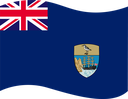
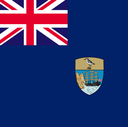
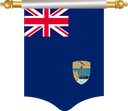
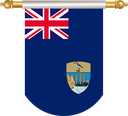
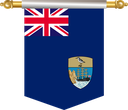
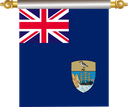
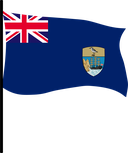
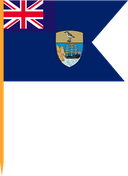
The flag of Saint Helena follows the traditional British Blue Ensign format used by many British Overseas Territories.
It features:
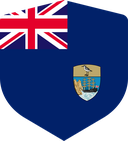
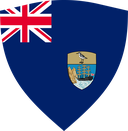
- A dark blue field
- The Union Jack in the upper hoist corner
- The coat of arms of Saint Helena displayed on the fly side
The coat of arms is positioned centrally on the right half of the flag, clearly visible against the blue background.
This design ensures immediate recognition of British authority while highlighting Saint Helena’s distinct identity.
Meaning of the Colors and Symbols
Each element of the Saint Helena flag carries symbolic meaning.
The blue background represents the Atlantic Ocean surrounding the island and symbolizes loyalty and stability.
The Union Jack signifies Saint Helena’s status as a British Overseas Territory and its constitutional connection to the United Kingdom.
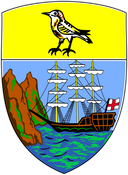
The coat of arms is rich in local symbolism:
- A sailing ship represents maritime history and the island’s role as a strategic stop on historic trade routes
- A green mountainous landscape reflects Saint Helena’s rugged terrain
- A bird (wirebird) symbolizes local wildlife and uniqueness, as the Saint Helena plover is endemic to the island
Together, these symbols highlight geography, history, and natural heritage.
Historical Background and Adoption
Saint Helena was discovered by the Portuguese in 1502 and later became a British possession in the 17th century. Due to its isolated location, the island played a strategic role in global navigation.
Saint Helena became world-famous when Napoleon Bonaparte was exiled there from 1815 until his death in 1821. During this period, the island gained lasting historical significance.
The current flag was officially adopted on October 4, 1984, when Saint Helena was granted its own coat of arms and flag, separate from earlier generic colonial designs.
More historical background can be found on the history of Saint Helena page.
Cultural and Territorial Significance
For residents, the Saint Helena flag represents local pride and community identity within a broader British framework.
The wirebird symbol is especially important, as it exists nowhere else in the world and has become a strong emblem of the island.
Among British Overseas Territory flags, Saint Helena’s design is often compared with the Flag of Ascension Island and the Flag of Tristan da Cunha, which share regional and administrative ties.
Official Use and Flag Etiquette
The flag of Saint Helena is flown at:
- Government buildings
- Public institutions
- Official ceremonies and events
It is commonly displayed alongside the Flag of the United Kingdom during official visits and national occasions.
Respectful handling of the flag is encouraged. It should be kept clean and displayed correctly according to established protocol.
The Flag in Modern Saint Helena
In modern Saint Helena, the flag continues to symbolize governance, heritage, and international identity. It appears in education, tourism promotion, and official documentation.
With improved transport links in recent years, the flag has gained increased international visibility, representing the island on the global stage.
The design reinforces Saint Helena’s distinct identity while maintaining constitutional continuity.
Design Strength and Recognition
The Saint Helena flag effectively balances British tradition with local symbolism. The Blue Ensign format ensures recognition, while the coat of arms tells a unique story.
The inclusion of landscape and wildlife imagery adds depth without overcrowding the design.
Its clarity and symbolism make it one of the more distinctive British Overseas Territory flags.
Questions About the Flag of Saint Helena
When was the Saint Helena flag adopted?
It was officially adopted on October 4, 1984.
Why does the flag include the Union Jack?
Because Saint Helena is a British Overseas Territory.
What does the bird on the coat of arms represent?
It represents the Saint Helena plover, also known as the wirebird.
Is Saint Helena an independent country?
No, it is a territory of the United Kingdom.
Is the Saint Helena flag the same on both sides?
Yes, the design appears on both sides of the flag.