Official Flag Status of Northern Ireland
Northern Ireland is a constituent part of the United Kingdom, and therefore the Union Flag (Union Jack) is the only official flag used for governmental and legal purposes. It represents sovereignty, constitutional authority, and international representation.
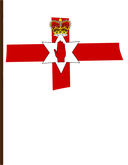
The Ulster Banner, sometimes referred to as the former Northern Ireland flag, was officially used between 1953 and 1972. Although it no longer has official legal status, it continues to appear in cultural, sporting, and historical contexts. More background on this can be found on the history of Northern Ireland page.
Design of the Union Flag in Northern Ireland
The Union Flag consists of a blue field with a red cross of St George edged in white, overlaid with the diagonal red cross of St Patrick and the white diagonal cross of St Andrew.
In Northern Ireland, the Union Flag is flown at government buildings, courts, and official institutions. It represents unity between England, Scotland, and Northern Ireland under the United Kingdom.
Design of the Ulster Banner
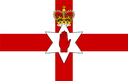
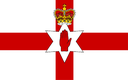
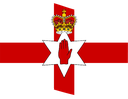
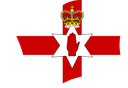
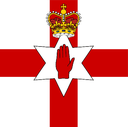
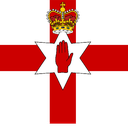
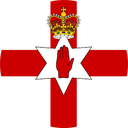
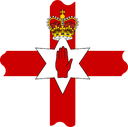
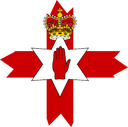
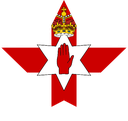
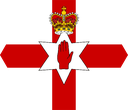
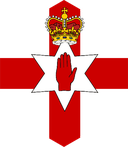
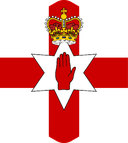
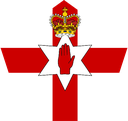
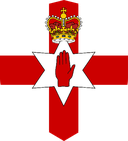
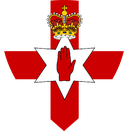
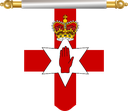
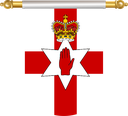
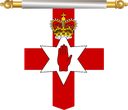
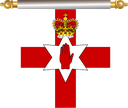
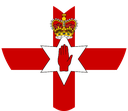
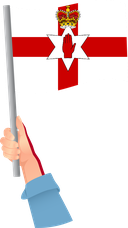
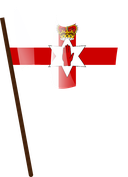
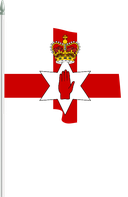
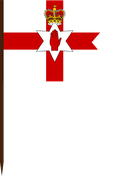
The Ulster Banner features a white field with a red cross, known as the Cross of St George. At the center of the cross is a six-pointed white star, representing the six counties of Northern Ireland.
Inside the star appears a red hand, a historic symbol of the province of Ulster. Above the star is a golden crown, representing the British monarchy.
Although no longer an official flag, the Ulster Banner remains widely recognized and is often associated with Northern Ireland in international sporting events.
Meaning of the Symbols
Each flag associated with Northern Ireland carries layered symbolism.
The Union Flag represents constitutional unity, governance, and the political connection to Great Britain. Its crosses symbolize the union of different nations under one state.
The red cross on the Ulster Banner represents English heritage and historical ties.
The six-pointed star symbolizes the six counties of Northern Ireland.
The red hand of Ulster is an ancient symbol associated with Irish mythology and regional identity, representing strength and heritage.
The crown symbolizes loyalty to the monarchy and constitutional authority.
Together, these symbols reflect both regional identity and political affiliation.
Historical Background and Flag Usage
Northern Ireland was created in 1921 following the partition of Ireland. From 1953 until 1972, the Ulster Banner was used by the Northern Ireland government.
In 1972, the Northern Ireland Parliament was suspended, and the Ulster Banner lost its official status. Since then, the Union Flag has been the only official flag used in government contexts.
Despite this, the Ulster Banner remains commonly used in sports and cultural representation, especially by teams representing Northern Ireland internationally.
Cultural and Political Significance
Flag usage in Northern Ireland is closely tied to identity and political history. Different communities may associate with different flags based on cultural background and political perspective.
The Union Flag is commonly associated with unionist identity, while Irish tricolor symbolism is associated with nationalist identity. The Ulster Banner occupies a distinct place as a historical regional symbol.
This complexity makes Northern Ireland’s flag situation unique compared to most regions.
Official Use and Flag Etiquette
The Union Flag is flown at official buildings in Northern Ireland on designated days according to UK government guidelines.
Due to historical sensitivity, flag display is often regulated carefully to promote respect and community balance. Public institutions follow strict protocols regarding when and where flags may be flown.
The Ulster Banner is not used for official government purposes but may appear in non-governmental contexts.
The Flags in Modern Northern Ireland
In modern Northern Ireland, flags remain powerful symbols of identity. The Union Flag continues to represent governance and constitutional status.
The Ulster Banner persists in cultural memory and international sports, maintaining recognition despite its unofficial status.
The coexistence of multiple flags reflects Northern Ireland’s ongoing dialogue around identity, heritage, and political structure.
Design Recognition and Global Awareness
Internationally, Northern Ireland is most often represented by the Union Flag. However, the Ulster Banner is still widely recognized, particularly in football and cultural media.
The presence of multiple flag symbols makes Northern Ireland a distinctive case in flag studies.
Questions About the Flag of Northern Ireland
Does Northern Ireland have an official flag?
Yes, the Union Flag of the United Kingdom is the official flag.
What is the Ulster Banner?
It is a historic flag formerly used by Northern Ireland from 1953 to 1972.
Why are multiple flags associated with Northern Ireland?
Because of its complex political history and regional identity.
Is the Ulster Banner still used today?
Yes, mainly in sporting and cultural contexts.
Which flag represents Northern Ireland internationally?
The Union Flag represents Northern Ireland internationally.