Official Flag Status of Saint Martin
As an overseas collectivity of France since 2007, Saint Martin is constitutionally part of the French Republic. Because of this status, the French Tricolour is the only officially recognized flag.
The French flag is flown at:
- Government and administrative buildings
- Schools and public institutions
- Courts and official ceremonies
- International and diplomatic events
No separate official flag has been adopted for Saint Martin under French law. More political context can be found on the history of Saint Martin page.
Design of the Flag of France (Used in Saint Martin)
The official flag used in Saint Martin is the Flag of France, which consists of three vertical stripes:
- Blue on the hoist side
- White in the center
- Red on the fly side
This design represents French sovereignty, citizenship, and republican authority on the island.
Meaning of the French Flag in Saint Martin
In the local context, the French flag symbolizes:
- Legal governance and state authority
- Equal citizenship rights under French law
- Political unity with mainland France and the European Union
For residents, the flag represents stability, public services, and constitutional protections, while local culture remains distinctly Caribbean.
The Unofficial Flag of Saint Martin
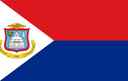
Alongside the French flag, Saint Martin is often represented by an unofficial local flag that features the coat of arms of Saint Martin.
This flag has no legal status, but it is widely used in:
- Cultural events
- Tourism promotion
- Local ceremonies
- Community identity expression
Design of the Unofficial Saint Martin Flag
The unofficial flag typically consists of:
- A white field
- The Saint Martin coat of arms centered on the flag
The coat of arms includes:
- A pelican, symbolizing local wildlife and Caribbean nature
- A rising sun, representing hope and a new beginning
- A ship, reflecting maritime history and trade
- A fleur-de-lis, symbolizing French heritage
Meaning of the Symbols
The pelican represents resilience and the island’s natural environment.
The rising sun symbolizes optimism, renewal, and future progress.
The ship reflects Saint Martin’s historical role in regional trade and navigation.
The fleur-de-lis reinforces the island’s political and cultural ties to France.
Together, these symbols express Saint Martin’s dual identity: Caribbean in culture, French in governance.
Historical Background of Flag Usage
Saint Martin was colonized by France and the Netherlands in the 17th century and remains one of the world’s few islands divided between two nations.
For centuries, the French tricolour served as the sole official flag on the French side of the island.
The coat of arms and its unofficial flag emerged in the modern era as a way to visually express local identity, especially after Saint Martin became a separate overseas collectivity in 2007.
Cultural and Social Significance
In everyday life, both flags may be seen:
- The French flag in official and governmental settings
- The unofficial Saint Martin flag in cultural festivals, tourism, and local branding
The unofficial flag allows residents to express pride in their island identity without challenging political status.
This dual-flag usage reflects the island’s multicultural and multinational character.
Official Use and Flag Etiquette
Only the French flag may be used for official representation and government authority.
The unofficial Saint Martin flag is freely used in private, cultural, and commercial settings without restrictions.
Both flags are generally displayed respectfully and peacefully.
The Flag in Modern Saint Martin
In modern Saint Martin, flag usage emphasizes balance rather than division. The French flag represents governance and international recognition, while the local flag celebrates culture and community.
The unofficial flag has become increasingly visible in tourism and cultural promotion.
Together, they visually represent Saint Martin’s layered identity.
Design Strength and Recognition
The French flag provides global recognition and legal clarity, while the unofficial Saint Martin flag offers local symbolism and storytelling.
This combination allows Saint Martin to express both constitutional belonging and cultural individuality.
Questions About the Flag of Saint Martin
Does Saint Martin have its own official flag?
No, the French flag is the only official flag.
What flag is flown on government buildings?
The flag of France.
What is the unofficial Saint Martin flag?
A cultural flag featuring the island’s coat of arms.
Can the local flag replace the French flag?
No, it has no legal status.
Why are two flags often seen in Saint Martin?
One represents political authority, the other cultural identity.