Design of the Flag of the Marshall Islands
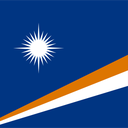
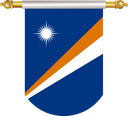
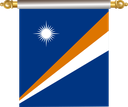
The flag of the Marshall Islands features a dark blue background symbolizing the Pacific Ocean. From the lower hoist side, two diagonal stripes extend upward toward the fly side. The upper stripe is white, and the lower stripe is orange, both stopping short of the corners of the flag.
In the upper hoist area, above the diagonal stripes, there is a prominent white star with 24 points, four of which are longer than the others. The diagonal layout gives the flag a sense of motion and progress, setting it apart from traditional horizontal or vertical flag designs commonly used around the world.
Meaning of the Colors and Symbols
Every element of the Marshall Islands flag carries specific symbolic meaning. The blue field represents the vast Pacific Ocean, which surrounds the islands and shapes daily life, transportation, and culture. It also reflects peace, loyalty, and the maritime character of the nation.
The white diagonal stripe represents the Ratak Chain, also known as the Sunrise Islands, while the orange stripe represents the Ralik Chain, or Sunset Islands. Together, these stripes show the unity of the two main island groups that form the Marshall Islands.
The white star symbolizes the nation’s location north of the equator, with the diagonal stripes acting as a stylized equatorial line. The star’s 24 points represent the 24 electoral districts of the country, while the four longer points highlight the major population centers: Majuro, Ebeye, Jaluit, and Wotje.
Historical Background and Adoption
The flag of the Marshall Islands was officially adopted on May 1, 1979, when the country became a self-governing republic in free association with the United States. The flag was designed by Emlain Kabua, who later served as the First Lady of the Marshall Islands.
Before gaining self-government, the islands were ruled under various foreign administrations, including German, Japanese, and American control. The introduction of a national flag marked a major milestone in the country’s political development. A more detailed overview of this period can be found on the history of the Marshall Islands page.
Cultural and National Importance
The Marshall Islands flag holds strong cultural significance and is closely tied to national identity. It is prominently displayed during Constitution Day celebrations, independence events, and official ceremonies. Internationally, the flag represents the Marshall Islands at global organizations and regional Pacific forums.
Among Pacific island nations, the flag shares thematic elements with the Flag of Micronesia and the Flag of Palau, yet its diagonal design and detailed symbolism make it visually unique. It reflects both traditional island values and a forward-looking national vision.
Official Use and Flag Etiquette
The flag of the Marshall Islands is flown at government buildings, schools, and diplomatic missions. It is also used on ships registered in the country and during international meetings. While flag regulations are not overly strict, respectful handling is encouraged, as the flag represents national unity and sovereignty.
During official events, the flag is usually raised at sunrise and lowered at sunset. When displayed alongside other national flags, it is treated with equal respect and prominence.
Questions About the Flag of the Marshall Islands
When was the flag of the Marshall Islands adopted?
The flag was officially adopted on May 1, 1979, when the country achieved self-government.
What do the diagonal stripes on the flag represent?
They represent the Ratak (Sunrise) and Ralik (Sunset) island chains.
Why does the star have 24 points?
The 24 points symbolize the country’s 24 electoral districts.
What is the meaning of the four longer star points?
They represent the major population centers of the Marshall Islands.
What does the blue background symbolize?
It represents the Pacific Ocean and the nation’s maritime environment.