Official Flag Status of Saint Pierre and Miquelon
Saint Pierre and Miquelon is an overseas collectivity of France, and as such, the French Tricolour is the only legally recognized flag.
The French flag is flown at:
- Government and administrative buildings
- Schools and public institutions
- Courts and official ceremonies
- International and diplomatic events
No separate official territorial flag has been adopted. More background on governance can be found on the history of Saint Pierre and Miquelon page.
Design of the Flag of France (Used in Saint Pierre and Miquelon)
The official flag used in Saint Pierre and Miquelon is the Flag of France, consisting of three vertical stripes:
- Blue on the hoist side
- White in the center
- Red on the fly side
This design represents French sovereignty, citizenship, and republican values across all French territories.
The Unofficial Flag of Saint Pierre and Miquelon
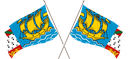
Alongside the French flag, Saint Pierre and Miquelon is widely represented by an unofficial local flag that reflects the territory’s history and cultural roots.
This flag has no official legal status, but it is commonly used in cultural events, tourism promotion, and local identity expression.
Design of the Unofficial Saint Pierre and Miquelon Flag
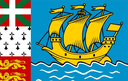
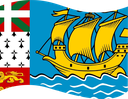
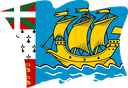
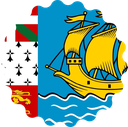
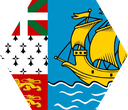
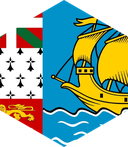
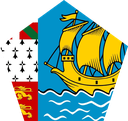
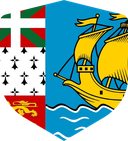
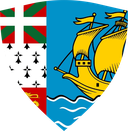
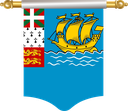
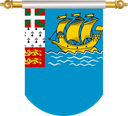
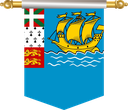
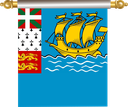
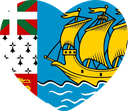
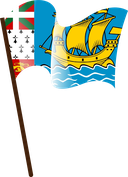
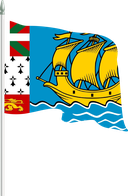
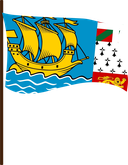
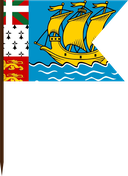
The unofficial flag features a yellow ship sailing on a blue wave, with three vertical panels on the hoist side:
- Basque flag
- Breton flag
- Norman flag
The ship faces toward the fly side, symbolizing exploration and settlement.
Meaning of the Colors and Symbols
Each element of the unofficial flag carries historical meaning.
The ship represents maritime heritage, fishing traditions, and the Atlantic crossing made by early settlers.
The blue wave symbolizes the Atlantic Ocean and the importance of the sea to local life.
The Basque, Breton, and Norman panels represent the primary regions of France from which early settlers originated. These cultures strongly influenced language, customs, and community life.
The yellow color symbolizes hope, resilience, and the enduring spirit of the islanders.
Historical Background of Flag Usage
Saint Pierre and Miquelon has a long history linked to fishing and transatlantic trade. Settled primarily by fishermen from western France, the islands changed control between France and Britain multiple times before permanently returning to France in 1816.
Because the territory never became an independent state, the French flag remained the official symbol. The unofficial local flag emerged in the late 20th century as a way to celebrate heritage and distinguish the islands culturally.
Cultural and Social Significance
In daily life, both flags are commonly seen:
- The French flag in official and governmental contexts
- The unofficial Saint Pierre and Miquelon flag during festivals, cultural events, and tourism promotion
The local flag is especially popular during celebrations related to fishing heritage and regional identity.
It allows residents to express pride in their unique North Atlantic culture while remaining fully French.
Official Use and Flag Etiquette
Only the French flag may be used for official representation and government authority.
The unofficial Saint Pierre and Miquelon flag is freely displayed in cultural, private, and commercial settings without restrictions.
Both flags are generally displayed respectfully, reflecting harmony between political status and cultural identity.
The Flag in Modern Saint Pierre and Miquelon
In modern times, the unofficial flag has become a recognizable symbol of the islands. It appears in logos, souvenirs, educational materials, and cultural exhibitions.
The coexistence of the French flag and the local flag highlights Saint Pierre and Miquelon’s dual identity: geographically North American, politically and culturally French.
This balance defines the territory’s modern image.
Design Strength and Recognition
The French flag provides international recognition and legal clarity, while the unofficial flag offers strong storytelling and local symbolism.
The inclusion of regional French flags makes the unofficial design unique among overseas territories.
Together, they communicate history, heritage, and belonging effectively.
Questions About the Flag of Saint Pierre and Miquelon
Does Saint Pierre and Miquelon have an official flag?
No, the French flag is the only official flag.
What does the ship on the local flag represent?
It represents maritime history and fishing heritage.
Why are Basque, Breton, and Norman flags shown?
They represent the origins of early settlers.
Can the local flag replace the French flag?
No, it has no legal status.
Why are two flags often used?
One represents political authority, the other cultural identity.