Design of the Flag of British Antarctic Territory
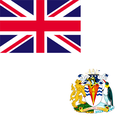
The flag of the British Antarctic Territory is a British Blue Ensign with a distinctive territorial coat of arms displayed on the fly side. The Union Jack appears in the upper hoist-side corner, representing the United Kingdom.
The coat of arms features a white field symbolizing ice and snow, with a red lion holding a torch above a blue wavy base. The design combines traditional British heraldry with imagery that reflects Antarctica’s extreme environment. The overall layout follows the standard format used by many British Overseas Territories.
Meaning of Colors and Symbols
Each element of the flag carries symbolic meaning. The blue field represents the Southern Ocean surrounding Antarctica and reflects loyalty and stability. The Union Jack symbolizes British sovereignty and historical claims.
The white background of the coat of arms represents Antarctica’s ice-covered landscape and purity. The red lion symbolizes strength, authority, and the United Kingdom’s historical presence. The torch held by the lion represents scientific research, discovery, and enlightenment. The blue waves symbolize the surrounding seas and Antarctica’s isolation.
Together, these symbols emphasize research, protection, and lawful administration rather than political control.
Historical Background of the British Antarctic Territory Flag
The British Antarctic Territory was formally established in 1962, separating it administratively from the Falkland Islands Dependencies. The territory’s flag was adopted later, in 1998, when a distinct coat of arms was granted.
The creation of a separate flag helped distinguish the territory’s administrative identity while maintaining British symbolism. The flag reflects Britain’s long history of Antarctic exploration and scientific involvement. Readers interested in this development can explore more details on the History of British Antarctic Territory page.
Scientific and Environmental Significance
The flag of the British Antarctic Territory represents a region dedicated to science and environmental protection. Activities in the territory are governed by the Antarctic Treaty System, which promotes peaceful research and international cooperation.
The torch symbol on the flag highlights the importance of scientific discovery. The territory plays a major role in climate research, glaciology, and environmental monitoring, making the flag a symbol of knowledge rather than settlement.
Relationship to Other British Territorial Flags
Like many British Overseas Territory flags, the British Antarctic Territory flag follows the Blue Ensign format. However, its symbolism is unique due to the absence of permanent residents and political institutions.
Compared to flags of inhabited territories, this flag focuses more on environmental and scientific imagery. This makes it distinct among British territorial flags and reflective of Antarctica’s special legal status.
Modern Use of the Flag of British Antarctic Territory
Today, the flag of the British Antarctic Territory is used in official documents, research stations, and administrative contexts. It may be flown at British research bases in Antarctica and during formal international scientific events.
The flag is also used in educational materials related to Antarctic governance and environmental protection. Its use reinforces Britain’s role in scientific research and international cooperation.
Interesting Facts About the Flag of British Antarctic Territory
- The flag was adopted in 1998.
- It uses the British Blue Ensign design.
- The torch symbolizes scientific research.
- The territory has no permanent population.
- It operates under the Antarctic Treaty System.
Frequently Asked Questions
Does the British Antarctic Territory have its own flag?
Yes, it uses a Blue Ensign with a unique territorial coat of arms.
What does the torch on the flag represent?
It symbolizes science, discovery, and research.
When was the flag of British Antarctic Territory adopted?
The flag was adopted in 1998.
Is the British Antarctic Territory inhabited?
No, it has no permanent civilian population.
Where is the flag commonly used?
It is used at research stations and in official documents.