Design of the Flag of Honduras
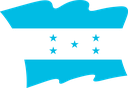
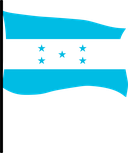
The Flag of Honduras consists of three horizontal stripes of equal width. The top and bottom stripes are blue, while the middle stripe is white.
Centered on the white stripe are five blue five-pointed stars arranged in an X-shaped pattern. The layout is balanced and symmetrical, making the flag easily recognizable both within Central America and internationally.
Meaning of Colors and Symbols
Each element of the Flag of Honduras carries strong symbolic meaning.
The blue stripes represent the Pacific Ocean and the Caribbean Sea, which border Central America. They also symbolize loyalty, justice, and perseverance.
The white stripe represents peace, purity, and the hope for unity among the nation’s people.
The five blue stars represent the five original Central American republics: Honduras, Guatemala, El Salvador, Nicaragua, and Costa Rica. The central star symbolizes Honduras itself, while the surrounding stars reflect the dream of regional unity and cooperation.
Together, the colors and stars express independence, peace, and Central American solidarity.
Historical Background of the Honduras Flag
The Flag of Honduras was officially adopted in 1866, inspired by the flag of the former Federal Republic of Central America, of which Honduras was a member.
Honduras gained independence from Spain in 1821 and later became part of the Central American federation. Although the federation eventually dissolved, its ideals of unity remained influential in national symbols.
The five stars were added to the flag to emphasize Honduras’s continued connection to regional cooperation. Readers interested in this period can explore more context on the History of Honduras page.
Cultural and National Significance
The Flag of Honduras holds deep cultural importance and represents national pride, unity, and sovereignty. It reflects the country’s independence and its place within the Central American region.
The flag is prominently displayed during Independence Day celebrations on September 15, national holidays, and official ceremonies. For Hondurans, it symbolizes freedom, shared heritage, and hope for regional harmony.
Relationship to Other Central American Flags
The Flag of Honduras closely resembles the flags of Nicaragua and El Salvador, which also use blue and white stripes inspired by the Central American federation.
What makes Honduras’s flag unique is the five-star arrangement, which clearly emphasizes the idea of regional unity. Comparing Central American flags highlights shared history alongside individual national identity.
Modern Use of the Flag of Honduras
Today, the Flag of Honduras is flown on government buildings, schools, and public spaces throughout the country. It is also displayed at embassies, international organizations, and global sporting events representing Honduras abroad.
The flag plays an important role in education and civic life, helping citizens understand independence, cooperation, and national responsibility. Its continued use reinforces Honduras’s identity as a sovereign Central American nation.
Interesting Facts About the Flag of Honduras
- The flag was adopted in 1866.
- The five stars represent Central American unity.
- The colors reflect oceans and peace.
- It was inspired by a regional federation.
- Honduras occupies the central star position.
Frequently Asked Questions
What do the stars on the Honduras flag represent?
They represent the five original Central American republics.
When was the Flag of Honduras adopted?
It was officially adopted in 1866.
Why does the Honduras flag use blue and white?
The colors symbolize oceans, peace, and unity.
Is the Honduras flag linked to other Central American flags?
Yes, it shares design roots with regional flags.
Where is the Honduras flag commonly displayed?
It is flown on public buildings and during national events.