Design of the Flag of Saba
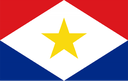
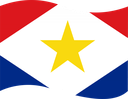
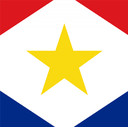
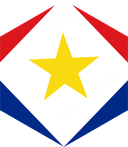
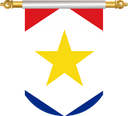
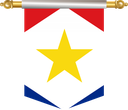
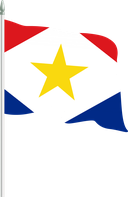
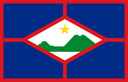
The flag of Saba features a central blue five-pointed star placed within a white diamond. Surrounding the white diamond are four triangular fields:
- Red at the top and bottom
- Blue on the left and right
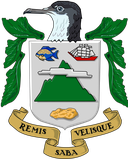
At the center of the blue star is the coat of arms of Saba, which includes additional local symbols.
The geometric layout is bold and symmetrical, making the flag visually striking and easy to recognize.
Meaning of the Colors
Each color on the Saba flag carries symbolic meaning connected to the island’s identity.
The blue color represents the Caribbean Sea and the sky, highlighting Saba’s island geography and maritime surroundings. It also symbolizes loyalty and stability.
The red color stands for courage, strength, and determination, reflecting the resilience of the island’s people in a rugged volcanic environment.
The white color symbolizes peace, unity, and clarity, emphasizing harmony within the small community.
Together, these colors reflect balance between nature, strength, and cooperation.
Meaning of the Symbols
The blue star at the center of the flag represents unity and guidance. It symbolizes Saba as a single community with a shared direction.
The coat of arms within the star includes:
- A green mountain, representing Mount Scenery, the highest point in the Kingdom of the Netherlands
- A ship, symbolizing maritime history and connection to the wider world
- A lion, reflecting historical ties to the Netherlands
The coat of arms reinforces local identity while acknowledging constitutional ties.
Historical Background and Adoption
Saba was first settled by Europeans in the 17th century and later became part of Dutch colonial holdings in the Caribbean. Over time, the island developed a close-knit community shaped by isolation and self-reliance.
In 1985, Saba officially adopted its flag and coat of arms to express local identity within the Kingdom of the Netherlands.
After the dissolution of the Netherlands Antilles in 2010, Saba became a special municipality of the Netherlands. The flag remained unchanged, continuing to represent local heritage and autonomy.
More historical background can be found on the history of Saba page.
Cultural and Local Significance
The Saba flag holds strong local significance and is proudly displayed during:
- Saba Day celebrations
- Cultural festivals
- Community events
- Official island ceremonies
For residents, the flag represents pride in their island’s independence of spirit, even while being politically connected to the Netherlands.
Among Caribbean flags, Saba’s design is distinctive due to its geometric structure and central star.
Relationship with the Flag of the Netherlands
As part of the Kingdom of the Netherlands, the Flag of the Netherlands is used for national and international representation. However, the Saba flag is used locally to express island identity.
Both flags are often displayed together during official events, reflecting constitutional status and local pride.
This dual-flag usage mirrors Saba’s political and cultural reality.
Official Use and Flag Etiquette
The flag of Saba is flown at local government buildings, schools, and public spaces on the island.
Respectful handling of the flag is encouraged. It should be kept clean, displayed correctly, and treated as a symbol of local unity and heritage.
There are no complex restrictions on civilian use, and residents freely display the flag during celebrations.
The Flag in Modern Saba
In modern Saba, the flag remains a strong symbol of community identity. It appears in tourism promotion, education, and cultural branding.
The flag reinforces Saba’s image as a distinct and proud island with deep local traditions.
Despite its small population, Saba’s flag ensures strong recognition within the Caribbean and the Dutch Kingdom.
Design Strength and Recognition
The Saba flag is praised for its bold geometry and clear symbolism. The central star draws immediate attention, while the surrounding colors create balance and contrast.
The inclusion of local symbols within the coat of arms adds depth without overcrowding the design.
Its uniqueness makes it one of the most recognizable flags among Caribbean territories.
Questions About the Flag of Saba
When was the flag of Saba adopted?
It was officially adopted in 1985.
What does the blue star represent?
It represents unity and guidance for the island community.
Is Saba an independent country?
No, it is a special municipality of the Netherlands.
What is Mount Scenery on the flag?
It represents the island’s highest mountain and natural identity.
Is the Saba flag the same on both sides?
Yes, the design appears on both sides of the flag.