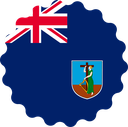
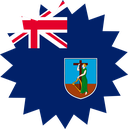
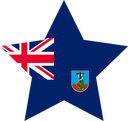
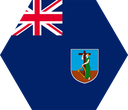
Design of the Flag of Montserrat
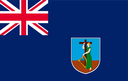
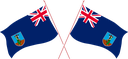
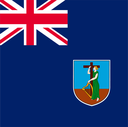
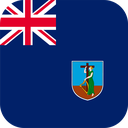
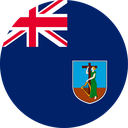
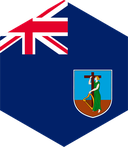
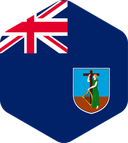
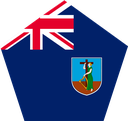
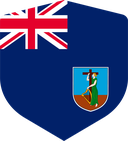
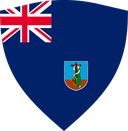
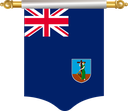
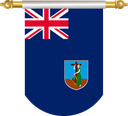
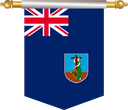
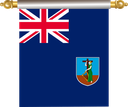
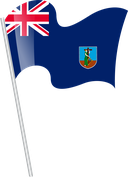
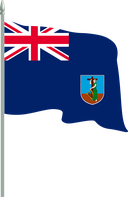
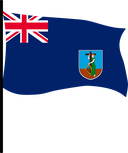
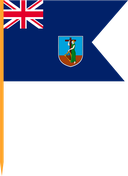
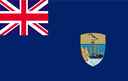
The flag of Montserrat follows the traditional British Blue Ensign design. It features a dark blue field with the Union Jack positioned in the upper hoist corner.
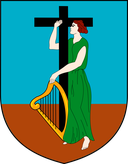
On the fly side of the flag appears the coat of arms of Montserrat, displayed prominently. The coat of arms shows a female figure standing beside a golden harp, holding a cross. This emblem distinguishes the Montserrat flag from other British Overseas Territory flags while maintaining a consistent overall structure.
The proportions and layout are standardized to align with British ensign traditions, ensuring the flag is easily recognizable within the wider family of British territorial flags.
Meaning of the Colors and Symbols
Each element of the Montserrat flag carries symbolic meaning. The blue background represents loyalty, stability, and the island’s maritime environment. Blue is commonly used in British ensigns and reflects Montserrat’s status as a territory under British sovereignty.
The Union Jack symbolizes Montserrat’s constitutional link to the United Kingdom and its political status as a British Overseas Territory.
The female figure on the coat of arms is Erin, a personification of Ireland. This reflects Montserrat’s strong Irish heritage, which dates back to the 17th century when many Irish settlers arrived on the island. For this reason, Montserrat is sometimes referred to as the “Emerald Isle of the Caribbean.”
The golden harp is a traditional Irish symbol, reinforcing the island’s cultural connection to Ireland. The cross represents Christianity and faith, which have played an important role in Montserrat’s history and social life.
Historical Background and Adoption
Montserrat was colonized by the British in 1632 and has remained under British administration since then, despite periods of French occupation. Over time, the island developed its own local symbols to reflect its identity within the British framework.
Earlier versions of Montserrat’s flag used different representations of the coat of arms. The current version, featuring the updated coat of arms, was officially adopted in 1999. This update helped standardize Montserrat’s visual identity and align it with modern heraldic practices. More historical context can be found on the history of Montserrat page.
Cultural and Political Significance
The Montserrat flag is an important symbol of local identity and governance. It is used during national holidays, official ceremonies, and cultural events. While Montserrat does not have an independent national flag, its territorial flag provides a distinct visual identity within the British system.
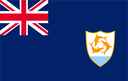
Among Caribbean territories, Montserrat’s flag is often compared with the Flag of Anguilla and the Flag of the Cayman Islands, which also use the Blue Ensign format. However, Montserrat’s Irish-inspired emblem makes it unique in the region.
Official Use and Display
The flag of Montserrat is flown at government buildings, schools, and official institutions across the island. It is also displayed at international events where Montserrat is represented as a British Overseas Territory.
The flag is commonly flown alongside the Flag of the United Kingdom, particularly during official visits and ceremonies. Respectful handling and proper display are encouraged in accordance with British flag protocols.
The Flag in Modern Montserrat
In modern Montserrat, the flag represents resilience and continuity. Following volcanic eruptions in the late 20th century that significantly affected the island, the flag has remained a symbol of unity and recovery.
It is frequently seen during cultural festivals, sporting events, and community gatherings, reinforcing a shared sense of identity among residents.
Design Consistency and Recognition
The Blue Ensign format ensures Montserrat’s flag is immediately recognizable as part of the British Overseas Territories. At the same time, the distinctive coat of arms allows the flag to express Montserrat’s unique cultural heritage.
This balance between unity and individuality is central to the flag’s design and symbolism.
Questions About the Flag of Montserrat
Is the flag of Montserrat a national flag?
No, it is a territorial flag used by a British Overseas Territory.
Why does the Montserrat flag include the Union Jack?
It represents Montserrat’s constitutional connection to the United Kingdom.
What does the woman with the harp symbolize?
She represents Ireland and reflects Montserrat’s Irish heritage.
When was the current Montserrat flag adopted?
The current design was adopted in 1999.
Is the Montserrat flag used internationally?
It is used in territorial representation, while the UK flag represents sovereignty.