Design of the Flag of Sudan
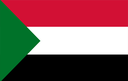
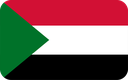
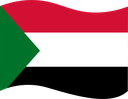
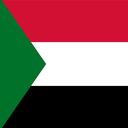
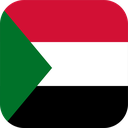
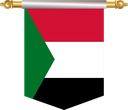
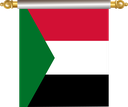
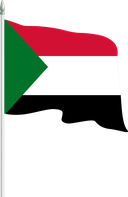
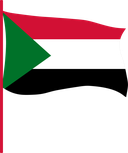
The Flag of Sudan features three horizontal stripes of equal width:
- Red on the top
- White in the middle
- Black on the bottom
At the hoist side is a green triangle extending inward across the stripes.
The design is balanced and instantly recognizable, with strong contrast between the colors and the triangular element.
Meaning of Colors and Symbols
Each color and symbol of the Flag of Sudan carries deep historical and cultural meaning.
The red stripe represents the blood shed by Sudanese people in the struggle for independence and freedom. It symbolizes courage and sacrifice.
The white stripe represents peace, optimism, and hope for unity among Sudan’s diverse communities.
The black stripe represents Sudan itself. The name “Sudan” historically refers to the “land of the black people,” making this color especially significant.
The green triangle represents Islam, agriculture, and prosperity. Green is strongly associated with Islamic heritage and growth.
Together, these elements express sacrifice, peace, identity, and faith.
Historical Background of the Sudan Flag
The Flag of Sudan was officially adopted on May 20, 1970, following a political change that led to a new national identity.
Before this, Sudan used a different flag after gaining independence from British-Egyptian rule in 1956. The earlier flag reflected different political values and symbolism.
The current design aligns Sudan with Pan-Arab colors, emphasizing cultural and political ties to the Arab world.
Readers interested in colonial and post-independence developments can explore more context on the History of Sudan page.
Cultural and National Significance
The Flag of Sudan holds strong emotional significance for its people. It represents sovereignty, resistance, and national pride.
The flag is prominently displayed during national holidays, political events, and public ceremonies. For Sudanese citizens, it symbolizes identity, unity, and hope for stability.
Despite political challenges, the flag remains a respected symbol of national continuity.
Relationship to Other Arab Flags
The Flag of Sudan shares similarities with other Arab national flags, such as those of Egypt, Iraq, and Yemen, which also use red, white, black, and green.
What distinguishes Sudan’s flag is the green triangle, which replaces stars or emblems used by other Arab states. Comparing Arab flags highlights shared heritage with unique national expression.
Modern Use of the Flag of Sudan
Today, the Flag of Sudan is flown on government buildings, schools, public institutions, and national landmarks across the country. It is also displayed at embassies and international forums representing Sudan abroad.
The flag plays an important role in civic education, helping citizens understand national history, identity, and independence. Its continued use reinforces Sudan’s place within the Arab and African worlds.
Interesting Facts About the Flag of Sudan
- It was adopted in 1970.
- It uses Pan-Arab colors.
- The black stripe reflects the country’s name.
- The green triangle symbolizes Islam.
- It replaced an earlier independence flag.
Questions About the Flag of Sudan
What do the colors of the Sudan flag represent?
Red represents sacrifice, white represents peace, black represents Sudan, and green represents Islam and prosperity.
When was the Flag of Sudan adopted?
It was adopted on May 20, 1970.
Why does the Sudan flag have a triangle?
The triangle represents Islamic heritage and growth.
Is the Sudan flag a Pan-Arab flag?
Yes, it uses traditional Pan-Arab colors.
Where is the Sudan flag commonly displayed?
It is flown on public buildings and during national events.