Design of the Flag of Nevada
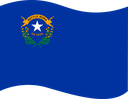
The flag of Nevada features a deep blue background with a silver-colored star placed in the upper hoist corner. Inside the star appears the word “Nevada.” Beneath the star is a green wreath composed of sagebrush branches, tied at the bottom with a ribbon bearing the state motto.
The motto reads “All For Our Country,” displayed in gold lettering. The overall design is compact and balanced, keeping all symbols grouped in the upper portion of the flag. This layout distinguishes Nevada’s flag from many other U.S. state flags that place their seals at the center.
Meaning of the Colors and Symbols
Each element of the Nevada flag carries clear symbolic meaning connected to the state’s identity.
The blue background represents loyalty, justice, and perseverance. Blue is commonly used in American state flags and provides a dignified and formal appearance.
The silver star symbolizes Nevada’s nickname, the Silver State, which comes from the discovery of rich silver deposits in the 19th century. The star also represents Nevada’s role as a U.S. state and its place within the Union.
The sagebrush wreath represents Nevada’s official state flower and reflects the state’s natural landscape and resilience in an arid environment. Sagebrush is a defining feature of Nevada’s terrain and symbolizes endurance and adaptability.
The state motto, “All For Our Country,” reflects Nevada’s commitment to national unity and service, emphasizing loyalty to the United States.
Historical Background and Adoption
Nevada became the 36th state of the United States in 1864, during the American Civil War. Its rapid admission to the Union reflected the strategic importance of its resources and political support.
Nevada adopted several earlier versions of its state flag before finalizing the current design. The original flag was adopted in 1905, with modifications made over time to improve clarity and symbolism. The current version was officially adopted in 1991, correcting spelling placement and refining design details.
These updates helped standardize the flag and ensure consistent representation. More historical background can be explored on the history of Nevada page.
Cultural and State Significance
The Nevada flag is primarily used in official contexts such as government buildings, schools, and civic ceremonies. It represents governance, public service, and state authority rather than decorative display.
Among U.S. state flags, Nevada’s design is often compared with the Flag of Arizona and the Flag of Colorado, though Nevada’s emphasis on mining heritage and native vegetation sets it apart.
The flag is commonly seen during state holidays, official proclamations, and educational events, reinforcing civic identity and pride.
Official Use and Flag Etiquette
The flag of Nevada is flown at the State Capitol, courthouses, schools, and municipal buildings. It is typically displayed alongside the Flag of the United States during official events.
Guidelines encourage respectful handling of the flag. It should be raised and lowered according to protocol and kept in good condition to reflect its status as an official state symbol.
Design Simplicity and Recognition
Nevada’s flag is valued for its simplicity and clear symbolism. By grouping all elements in one corner, the design avoids overcrowding while remaining distinctive.
The use of the silver star and sagebrush ensures instant association with Nevada’s identity, making the flag easily recognizable among U.S. state flags.
The Flag in Modern Nevada
In modern Nevada, the flag continues to represent growth, resilience, and loyalty. It is displayed during public celebrations, government announcements, and state-sponsored events.
Although Nevada has transformed from a mining frontier into a diverse modern economy, the flag preserves historical references that connect past and present.
Questions About the Flag of Nevada
When was the current flag of Nevada adopted?
The current version was adopted in 1991.
What does the silver star on the flag represent?
It represents Nevada’s nickname, the Silver State.
Why is sagebrush shown on the flag?
Sagebrush is Nevada’s state flower and symbolizes resilience.
What is the meaning of Nevada’s state motto?
“All For Our Country” reflects loyalty to the United States.
Is the Nevada flag the same on both sides?
Yes, the design appears on both sides of the flag.